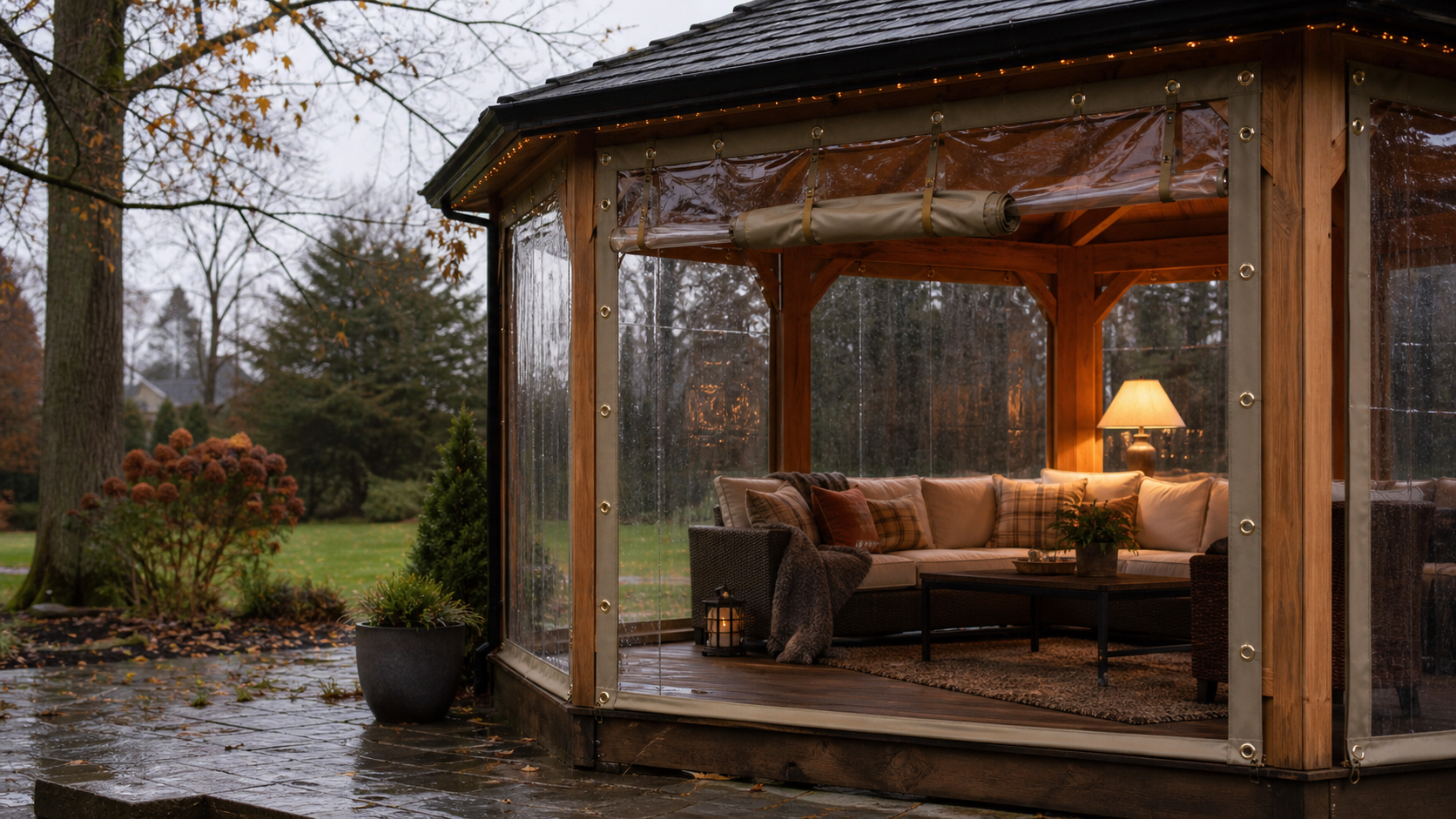
Wind damage usually begins with repeated movement. A loose middle section pumps back and forth, then force concentrates at the nearest grommet, zipper or corner seam. The solution is balanced support around the perimeter and a clear threshold for taking panels down.
Start at the top edge
The top carries the panel. Support it at regular intervals and confirm the beam or track can accept the load. Long unsupported spans sag and allow air to collect behind the sheet.
Control both vertical edges
A secured top with loose sides still behaves like a sail. Attach each vertical edge without twisting the panel. At shared corners, zipped or overlapped panels should transfer tension evenly rather than pulling against one isolated point.
Stabilize the bottom safely
Lower anchors reduce billowing, but ropes across an entrance create a hazard. Use planned hooks, a track, weighted pockets or straps positioned outside walking routes. Keep drainage paths open.
Do not over-tension
A panel should be supported, not stretched like a drum. Excess tension can deform zippers, elongate grommet holes and tear reinforced corners. Adjust opposing points in small increments.
Know the removal point
No attachment method makes flexible walls storm protection. Follow product limits and local forecasts. Roll or remove panels before severe weather, and never rely on them to brace the gazebo frame.
Look for perimeter reinforcement and attachment spacing that suit your frame.